
Commercial Metal Gate Installation in Elgin, IL — Business & Facility Entrance Specialists
Commercial openings get sized by the largest vehicle that has to clear them and by how many times a day the gate cycles. Neither number is the width of the drive.
Elgin Elite Metal Gates is your local resource for commercial metal gates, heavy-duty steel fabrication and facility entrance systems throughout Elgin, Kane County and the Fox Valley. We work with experienced fabricators who build to cycle count, not just to opening width.
A commercial gate and a residential gate can look identical and be entirely different machines. The difference is duty. A house gate cycles a few times a day; a business entrance can cycle sixty times, and every one of those multiplies the load through the hinges, welds, rollers and operator. Hardware that lasts fifteen years on a driveway can be worn out in two on a tenant lot.
The second difference is the vehicle. Commercial openings get sized by the largest thing that has to get through — a box truck needs turning room a sedan doesn't, and a semi tractor needs an approach angle that determines where the gate can physically sit. Measuring the drive width and building a gate to match is how properties end up with an entrance that delivery drivers clip every few weeks.
Downtime is the third. When a residential gate fails, someone opens it by hand. When a commercial gate fails, a dock backs up or tenants can't get in, which is why specification here leans toward serviceable, over-rated hardware rather than the cheapest thing that meets the load on paper.
What a Commercial Metal Gates Quote Covers
- Opening sized to the largest vehicle that has to clear it, including turning and approach angle
- Honest cycle-count assessment, since duty is what determines hardware more than weight does
- Heavy-gauge frame spec in writing — tube wall thickness, infill and total leaf weight
- Hinge, roller and track hardware rated well above the load rather than at it, for serviceability under cycling
- Post sizing and footings below Elgin's 42-inch frost depth, sized for commercial leaf weights
- Finish specified for a salted commercial approach, where plough and truck traffic is harder on coatings than a residential drive
- High-cycle operator selection where the gate is automated
- UL 325 entrapment protection and ASTM F2200 construction compliance on any automated installation
- Access control planned around tenants, staff and contractor turnover
- Permit coordination with the City of Elgin
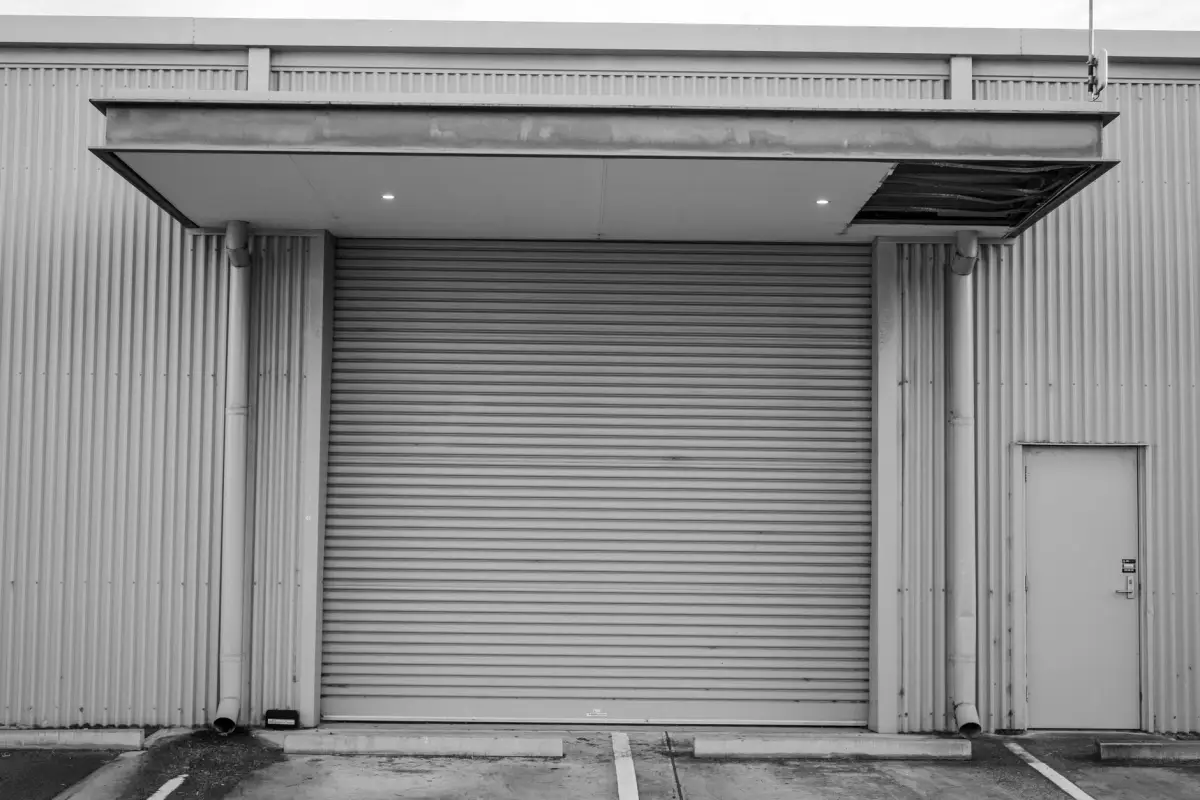
Commercial Metal Gate Installation in Elgin, IL
Commercial Entrance & Driveway Gates
The entrance gate is the one every vehicle and every visitor meets, which makes it both the highest-duty item on the property and the one that represents the business. Sizing starts with the largest vehicle: a box truck or a semi needs both width and approach angle, and a gate positioned without accounting for the turn will get clipped repeatedly by drivers doing nothing wrong. Setback from the roadway matters as much — a vehicle waiting for the gate needs to be clear of traffic, and on a commercial approach that vehicle may be considerably longer than a car. Then duty. An entrance gate cycling dozens of times daily needs hardware chosen for wear rather than for peak load, which usually means over-rating everything and choosing components that can be serviced rather than only replaced. The finish takes a beating too: a commercial approach gets ploughed and salted harder than a residential drive, which makes hot-dip galvanizing under powder coat the sensible default rather than an upgrade.
Commercial Sliding Gates
Slides dominate commercial work for a practical reason: a swing arc that intrudes into a traffic lane, a parking aisle or a dock apron isn't acceptable, and on most commercial sites there's nowhere for a leaf to arc into. A slide travels parallel to the fence line, so it needs run alongside rather than space in front. Cantilever designs carry the leaf on post-mounted rollers with nothing touching the ground, which matters more commercially than residentially: a ground-level V-track on a site with plough traffic and heavy vehicle loading gets packed, bent and damaged in ways a domestic drive never manages. Cantilever also removes the winter maintenance obligation, and on a commercial site that maintenance is somebody's job that won't get done. The tradeoff is longer required run for the counterbalance tail and heavier roller posts, since on a cantilever the posts carry the entire leaf. See sliding gates.
Commercial Swing Gates
Swing gates still have a place commercially, mainly on secondary entrances, staff lots and sites where the arc space genuinely exists. They're simpler, cheaper and have fewer wear points than a slide, which on a low-cycle secondary gate is a real advantage. What changes at commercial scale is the hinge and frame specification. A leaf that cycles sixty times a day applies its load sixty times a day, so hinges get rated well above the leaf weight and the frame gets bracing that a residential gate of the same size wouldn't need — a diagonal brace or internal tensioned cable, because racking under cycling is a matter of time otherwise. Bi-parting pairs are the norm at commercial widths, which adds a centre stop, drop rods and the requirement that the two leaves stay square to each other. On an automated pair, operator sequencing is what keeps them meeting properly.
Heavy-Duty Steel Gates
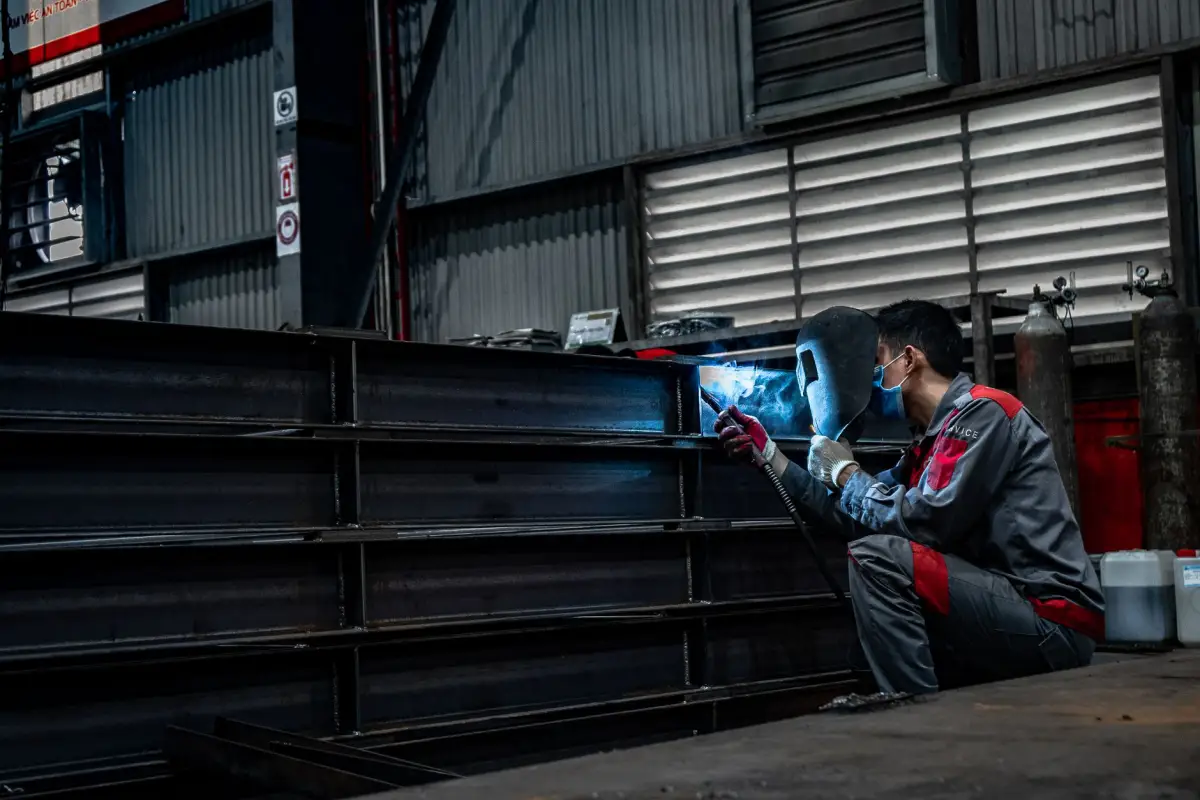
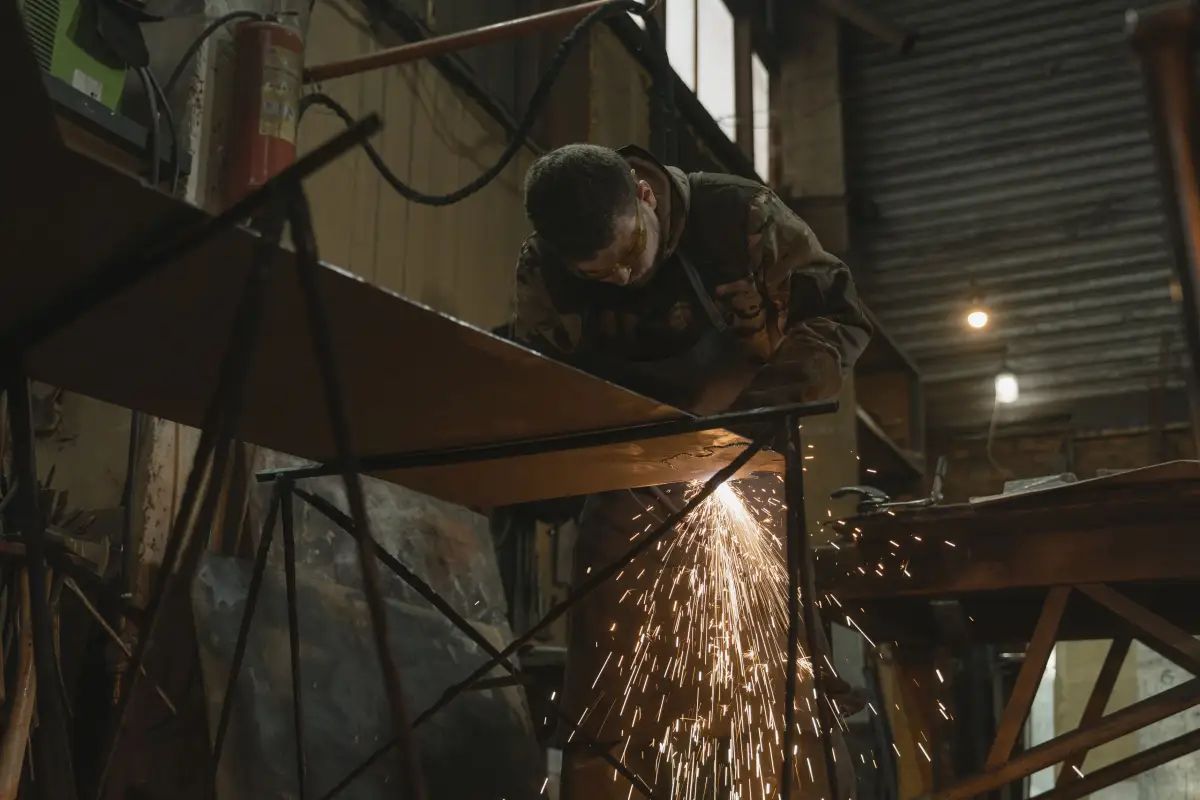
Heavy-duty is a specification, not an adjective, and it's worth pinning down on any quote. It means frame tube with genuine wall thickness rather than the lightest section that meets the span, infill fixed so it can't be levered out, welds that are continuous where they carry load rather than stitched, and hardware rated with real margin above the calculated load. Where a gate has to resist impact as well as weight — a dock approach where vehicles manoeuvre close, or an entrance clipped regularly by trailers — the frame gets designed so damage is repairable rather than terminal, which favours steel over aluminum decisively. Steel bends and gets straightened; aluminum dents and gets replaced. The cost of heavy-gauge fabrication is real, and it's justified by cycle count and impact exposure rather than by the label. On a low-traffic secondary gate it's money spent for nothing.
Custom Commercial Gate Fabrication
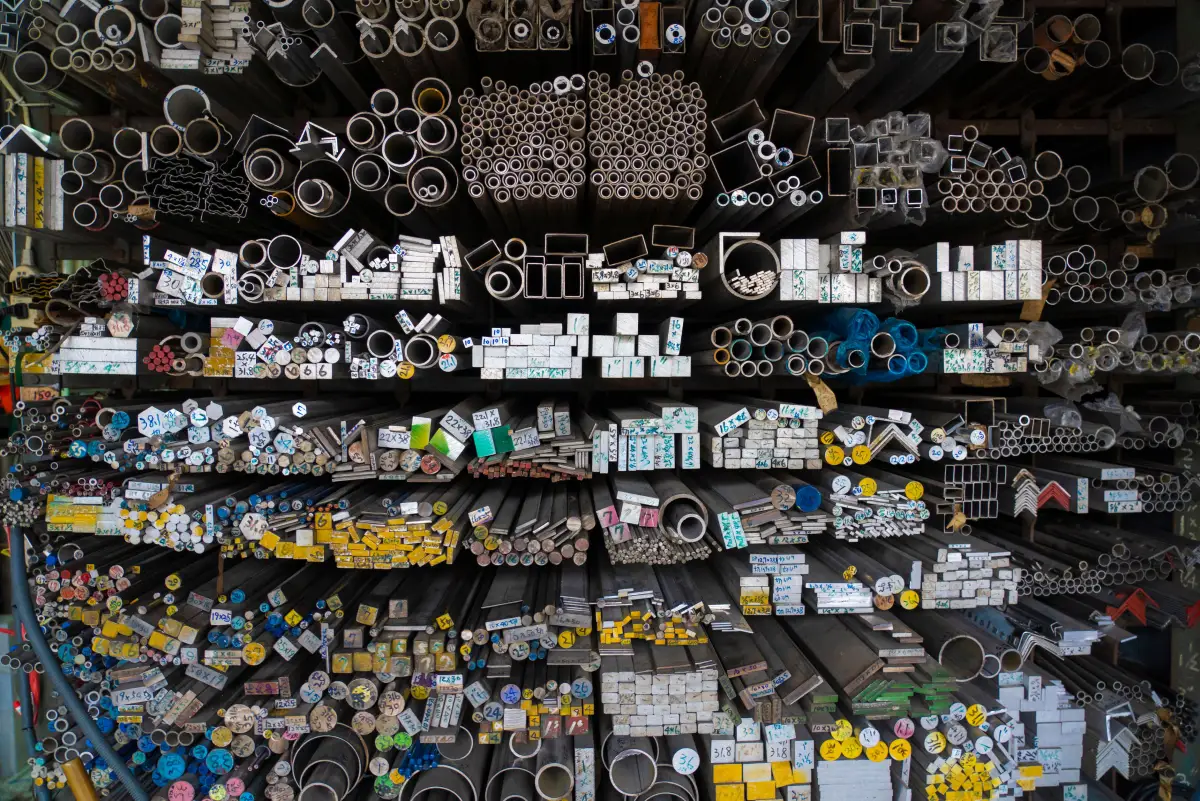
Most commercial gates are custom because commercial openings rarely match anything stock. The gate has to fit an existing fence line, clear a specific vehicle envelope, work with a particular grade across the approach, and often tie into an access control system that's already in place. Custom fabrication also allows the gate to be built for the site's actual failure risks: extra protection at the leading edge where trailers swing close, a bottom rail height that clears a dock apron that sits higher than the drive, reinforcement where a plough has hit the same corner three winters running. On a multi-gate site there's a further advantage in having entrances fabricated to a consistent specification — the same hardware across every gate means one spares inventory and one service familiarity rather than four. See custom metal gates for material and finish detail.
Signs Your Property Needs a Commercial-Grade Gate
- The existing gate is a residential-duty product on an entrance that cycles dozens of times a day
- Delivery vehicles clip the gate or the posts regularly, which means the opening was sized for cars
- Hinges, rollers or track have worn out faster than expected — a duty mismatch, not bad luck
- The gate blocks a traffic lane or a dock apron while it opens, pointing toward a slide
- Tenants, staff or contractors turn over and access can't be revoked individually
- Gate downtime stops deliveries or blocks a lot, making serviceability worth paying for
- A ground-level track is being damaged by plough and truck traffic every winter
How a Commercial Gate Gets Specified and Installed
- 1
Vehicle envelope and traffic survey
The survey starts with vehicles rather than with the opening. The largest vehicle that has to pass is identified and its turning and approach path traced, because a gate positioned without that path in mind will be struck by drivers doing nothing wrong. Setback from the roadway is measured against the length of that vehicle, since a semi waiting for a gate occupies considerably more road than a car does. Traffic flow through the site gets looked at — whether the gate can arc into anything, whether a queue would block a lane, whether entry and exit share an opening. Then cycle count, which gets established from actual site operation rather than estimated: deliveries, staff arrivals, tenant movements and contractor traffic add up faster than owners expect, and that number determines the hardware class for every component downstream.
- 2
Configuration and heavy-duty specification
Configuration follows the traffic survey — usually a slide on a commercial site, since arc space rarely exists and a swing gate blocking a lane is unacceptable. Then the specification gets written for duty rather than for static load. Frame tube wall thickness, infill and fixing method, and continuous welds where load is carried. Hinges, rollers and end stops rated with margin above the calculated load, because a component running at its limit under high cycling wears at a rate that makes the saving irrelevant. Serviceability is an explicit criterion at this stage: components that can be replaced individually without dismantling the gate are worth more on a commercial site than a marginally cheaper integrated assembly. Where the gate will be automated, the operator's usage class gets identified now — Class II for general-access commercial, Class III for industrial or limited-access, Class IV for restricted guarded sites.
- 3
Posts, footings and site works
A JULIE locate goes in before digging. Commercial gate posts carry substantially more load than residential ones — on a cantilever slide, the roller posts carry the entire leaf — and get sized and footed accordingly, below Elgin's 42-inch frost depth. Below it, not to it: a footing terminating inside the frost zone gets jacked each freeze-thaw cycle, and on a commercial slide that misalignment shows up as a gate binding at a point in its run and an operator working against it. Where the gate ties into existing fencing, the transition gets assessed honestly, since a heavy gate hung between light fence posts relocates the weak point rather than removing it. Conduit for power and low-voltage runs goes in while the ground is open, along with any detection loops, because cutting a finished commercial apron later is disruptive to operations as well as expensive.
- 4
Installation, automation and commissioning
Posts cure before load goes on them. The gate is hung or set and run through its full travel by hand, checked for binding at every point rather than only at the closed position, since anything an operator has to fight it will fight thousands of times a year here. Where the gate is automated, travel limits get set, obstruction sensitivity tuned, and on a bi-parting pair the operators sequenced so the passive leaf lands first. Every safety device is triggered and verified in both directions of travel — UL 325 requires two independent means of entrapment protection at each entrapment point per direction, and monitored devices are what post-2016 operators refuse to run without. ASTM F2200 construction items get checked: frame openings under 2.25 inches, smooth bottom edges with protrusions no greater than half an inch, and construction such that the gate won't fall more than 45 degrees from vertical if it detaches. Manual release and access credentials are handed over documented.
What Do Commercial Metal Gates Cost in Elgin, IL?
- Opening width driven by vehicle envelope rather than drive width
- Cycle count, which determines hardware class for every wearing component
- Frame gauge, infill and weld specification — the difference between heavy-duty and a label
- Configuration: cantilever slide, V-track slide or bi-parting swing
- Post sizing and footing depth, scaled to commercial leaf weights
- Finish system, with plough and salt exposure on a commercial approach favouring galvanizing under powder coat
- Automation class — Class II, III or IV operators are materially different machines
- Safety devices, one set per entrapment point per direction of travel
- Access control sized for tenant, staff and contractor turnover
- Site works: trenching, loop cutting, and any disruption to operations while the entrance is out of use
The cost that doesn't appear on a commercial gate quote is downtime. A gate that fails on a Monday morning and blocks a dock or a tenant lot costs more in a day than the difference between adequate and over-rated hardware. That's the real argument for specifying components with margin and choosing assemblies that can be serviced in parts rather than replaced whole — not durability for its own sake, but the ability to get the entrance working again quickly.
What to Look for in an Elgin Commercial Gate Contractor

The Vehicle Envelope Measured
The largest vehicle's turning and approach path, not the width of the drive. Gates sized for cars get clipped by trucks, and that's a design fault.
Cycle Count Established, Not Guessed
Duty determines hardware class for every wearing component. A contractor who hasn't asked how often the gate opens hasn't specified it.
'Heavy-Duty' Defined in Writing
Wall thickness, weld specification, hardware ratings. It's a spec, not an adjective, and it should appear on the quote as one.
Serviceability Treated as a Requirement
Components replaceable individually beat a cheaper integrated assembly on a site where downtime blocks operations.
Safety Devices Verified in Both Directions
Every entrapment point, each direction of travel, each device actually triggered. UL 325 compliance is a test, not a parts list.
Fixed Quotes, Decided On-Site
Vehicle paths, cycle count, ground conditions and tie-ins all checked before the number is set and before the entrance is taken out of service.
Residential & Commercial Commercial Metal Gates
Residential
Where a property is mixed-use or a large residential site — an apartment complex, a managed community — the gate is commercial in duty even though the users are residents. Cycle count and credential turnover follow commercial patterns, and specifying residential-duty hardware because the users live there is the most common mismatch on this kind of site.
Commercial
Business, retail, office and multi-tenant sites all share the same three drivers: vehicle size, cycle count and the cost of downtime. Those determine the specification far more than the appearance of the entrance does. See commercial automatic gates, commercial security gates and industrial gates.
When a Commercial Gate Isn't the Right Call
- The entrance is a low-traffic secondary gate opened a few times a week. Heavy-gauge fabrication is money spent on a duty that isn't there.
- Your existing commercial gate is sound and the problem is wear in the rollers, hinges or track. That's commercial gate repair, not replacement.
- What you actually need is control over who enters, on a gate that already works. That's access control.
- You need a barrier rated to stop a vehicle being driven through it. That's crash-rated engineered construction — a different product, and nobody should sell you an ornamental gate as one.
- The property is outside Kane, Cook, DuPage, McHenry and Lake Counties.
Related Services
- Commercial Automatic Gates in Elgin, IL
High-cycle operators and automated entry systems for business traffic.
- Commercial Security Gates in Elgin, IL
Perimeter, parking lot and controlled-access work.
- Commercial Gate Repair in Elgin, IL
Wear-driven repair and preventative maintenance at commercial duty cycles.
- Industrial & Heavy-Duty Gates in Elgin, IL
Warehouse, distribution and high-cycle systems beyond general commercial duty.
Serving Nearby Cities
Gate work across Kane, Cook, DuPage, McHenry & Lake Counties. Each city page covers the local permit requirements, footing depth and the configurations that come up most often there.
- South Elgin
- Streamwood
- Bartlett
- Carpentersville
- Hanover Park
- Hoffman Estates
- St. Charles
- Algonquin
- Schaumburg
- Lake in the Hills
- West Chicago
- Carol Stream
- Huntley
- Batavia
- Glendale Heights
- Palatine
- Crystal Lake
- Wheaton
- Arlington Heights
- Addison
- Lombard
- Mount Prospect
- Buffalo Grove
- Aurora
- Elmhurst
- Des Plaines
- McHenry
- Naperville
- Downers Grove
- Woodstock
Frequently Asked Questions
- What makes a gate commercial rather than residential?
- Duty cycle, mostly. A residential gate opens a few times a day; a commercial entrance can open dozens of times, and every cycle loads the hinges, welds, rollers and operator again. That multiplication is what drives heavier frame gauge, hardware rated with margin above the load, and higher operator usage classes. The second factor is vehicle size — commercial openings get sized by the largest vehicle that has to clear them, including its turning path.
- How wide should a commercial gate be?
- Wide enough for the largest vehicle plus its approach angle, which is usually wider than the drive itself suggests. A box truck or semi doesn't enter straight; it swings, and a gate positioned without tracing that path gets struck by drivers doing nothing wrong. Setback matters too — a waiting vehicle needs to be clear of the roadway, and a semi occupies considerably more road than a car while the gate opens.
- Should a commercial gate slide or swing?
- Slide, in most cases. Commercial sites rarely have arc space to spare, and a swing leaf blocking a traffic lane, a parking aisle or a dock apron isn't acceptable. Slides need run alongside the opening instead of space in front. Cantilever designs are usually preferred over ground-track ones on commercial sites, because plough and heavy vehicle traffic damage a ground-level track and nobody's job description includes clearing it every January.
- What does 'heavy-duty' actually mean on a gate quote?
- It should mean specific things: frame tube wall thickness stated, infill fixed so it can't be levered out, continuous welds where load is carried, and hardware rated with real margin above the calculated load. If those numbers aren't on the quote, 'heavy-duty' is an adjective rather than a specification. It's worth asking, because two quotes using the same phrase can describe materially different gates.
- How long do commercial gates last?
- It depends almost entirely on whether the hardware was matched to the actual cycle count. Components running at their rated limit under high cycling wear at a rate that makes the initial saving irrelevant within a couple of years, while over-rated hardware on the same gate keeps going. The other big factor here is finish — a commercial approach gets ploughed and salted harder than a residential drive, so galvanizing under powder coat is closer to a requirement than an upgrade.
- Do commercial gates need permits in Elgin?
- Fence and gate work in Elgin requires a building permit and work can't begin before it's issued. Commercial projects are subject to zoning approval like any other, and setback requirements vary by zoning district. Where the property sits within a historic district, a Certificate of Appropriateness applies in addition. Checking these before design rather than after is considerably cheaper.
Learn More
- City of Elgin — Common Residential Permits — Which residential projects need a permit in Elgin and how the application is filed.
- DASMA — An Installer's Guide to ASTM F2200 — The construction requirements an automated gate has to meet: gap limits, bottom-edge protrusions, and how the gate has to behave if it leaves its hardware.
- American Galvanizers Association — Duplex Systems — Why hot-dip galvanizing under powder coat outlasts either finish on its own, particularly where road salt is in play.
Get a Quote for Commercial Metal Gates in Elgin, IL
Send over the opening you’re working with and get an on-site measurement and quote — no charge for the estimate, no obligation to book it.
Get My Free Estimate