Pedestrian Gates in Elgin, IL — Residential & Commercial Walk Gate Specialists
A walk gate gets used far more often than the driveway gate beside it, which is why hinge and latch quality matter more here than anywhere else on the property.
Elgin Elite Metal Gates is your local resource for pedestrian gates, side yard gates and ornamental walk-through entrances throughout Elgin, Kane County and the Fox Valley. We work with experienced fabricators who build walk gates to survive the cycle count they actually see.
The walk gate is the most-used piece of metalwork on most properties. A driveway gate might cycle four times a day; a side yard gate gets opened every time someone takes the bins out, walks the dog, or cuts through to the back. That cycle count is why walk gates fail at the hinge and latch rather than in the frame, and why spending on hardware here returns more than spending on decoration.
The other thing that separates a good walk gate from a poor one is self-closing behaviour. A gate that doesn't return to its latch is a gate that stands open in wind, and repeated slamming is what loosens hinges and bends strikes. A properly adjusted closing spring or a gravity hinge set on a slight incline solves it without anyone thinking about it.
Beyond that, walk gates follow the same rules as everything else here: posts footed below Elgin's 42-inch frost depth, and a finish that assumes salt spray will reach the bottom rail every winter.
What a Pedestrian Gates Quote Covers
- Measurement of the clear opening, the swing arc and the ground clearance across it
- Latch height and type discussed against who uses the gate — a latch reachable from both sides is a different design from one deliberately not
- Frame and infill spec in writing, matched to any adjacent fencing or driveway gate
- Hinges rated for high cycle counts rather than for the leaf weight alone
- Self-closing hardware where it makes sense: closing spring or gravity hinge set to return the gate reliably
- Post footings below Elgin's 42-inch frost depth, with a JULIE locate placed first
- Finish system specified for ground-level salt exposure at the bottom rail
- Keyed, coded or access-controlled entry where the gate needs to be secure rather than just closed
- Permit guidance, including the historic-district Certificate of Appropriateness where it applies


Pedestrian Gate Installation in Elgin, IL
Front Entry Pedestrian Gates
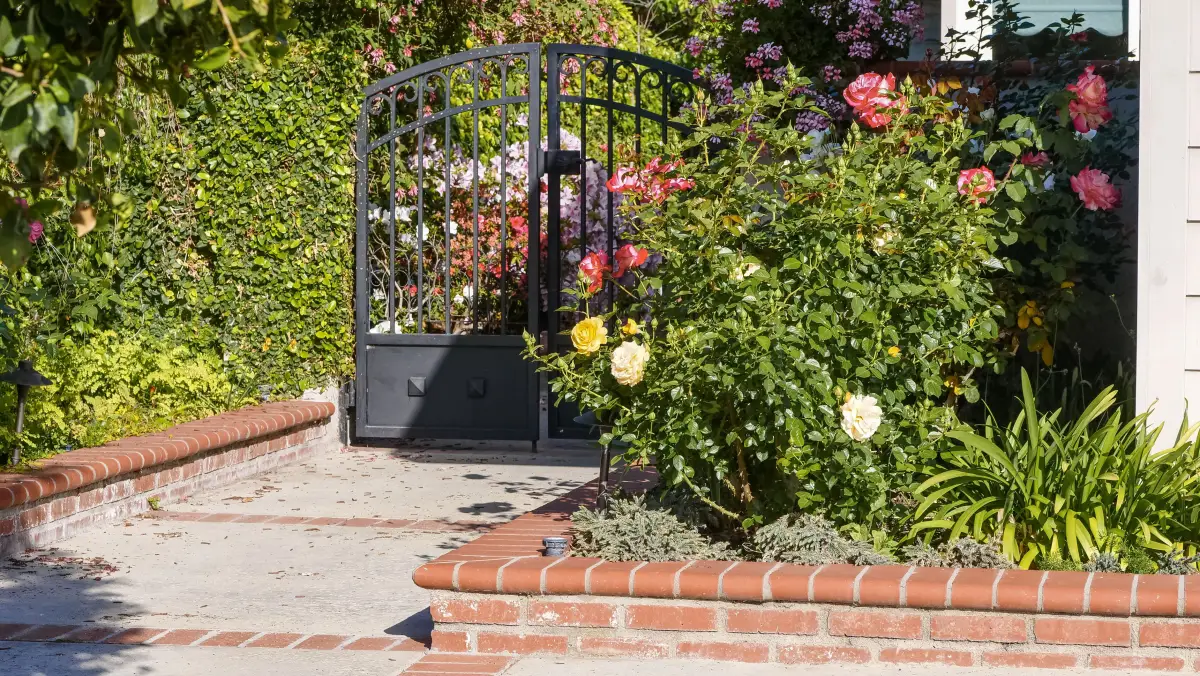
The front walk gate is the one people actually look at, which changes what it has to do. It sits in the street yard, so under Elgin's zoning it faces the tighter height limits that apply to any yard adjoining a street — 3 feet for solid designs and 4 feet at 40% open for a picket design. In a historic district the cap tightens further, to 42 inches at 50% open, and the design needs a Certificate of Appropriateness before it's built. Within those limits the design question is proportion: a short gate reads badly if the picket spacing and finial scale were drawn for a taller one. Hardware matters here too, since a front gate gets used by visitors who have no idea how it works — a latch that operates cleanly from the outside without a trick, and a gate that returns to its latch on its own rather than being left swinging.
Side Yard & Walkway Gates
Side yard gates take the most abuse of any gate on a property and get the least thought. They're narrow, often squeezed between a house wall and a fence line, and they get opened several times a day by people carrying something. The recurring failures are predictable: a latch that no longer lines up because the post has moved, a gate dragging on a path that frost has lifted, and hinges worn loose from sheer cycle count. Clearance is the design detail worth getting right — a side yard gate hung tight to a concrete path will bind the first winter, so it wants deliberate ground clearance and a bottom rail high enough to clear a frost-heaved slab. Where the gate is the only route to the back of the house, width is worth arguing about too: a 36-inch gate that a wheelbarrow or a mower won't fit through is a gate that gets propped open permanently.
Garden & Courtyard Gates
Garden and courtyard gates are the place where ornamental work makes the most sense per dollar, because they're seen up close and at a slow walking pace. Scrollwork, collars and hammered detail read properly at that distance in a way they don't on a driveway gate seen from a moving car. They're also usually short and light, which means the hardware isn't fighting much and can be chosen for looks more freely. Two practical notes. First, if the courtyard is enclosed and the gate is the only access, think about whether it needs to be openable from inside without a key — that's a safety consideration, not just a convenience one. Second, low gates in planted areas sit in damp ground and vegetation for months at a time, which is harder on a finish than open exposure. Galvanizing under the powder coat is worth more here than the size of the gate suggests.
Security Pedestrian Gates
A walk gate becomes a security gate when the design stops assuming cooperation. That means a few specific things rather than a general upgrade. Picket spacing gets tightened so nothing can reach through to the latch, and the latch itself gets shrouded or moved out of reach from the outside. Frame stock goes heavier so the gate can't be flexed away from its post. Hinges get non-removable pins or welded stops so the leaf can't be lifted off. Height goes up to whatever zoning permits — worth checking, since street-yard limits in Elgin are low and a genuinely secure front gate may not be permitted at the height you'd want. Where the gate needs to be more than locked, access control is the next layer: a keypad or fob reader gives entry without distributing keys, and logs who came through. For the vehicle side, see security gates.
Custom Metal Walk-Through Gates
Most walk gates get built custom for an unglamorous reason: the opening between an existing house wall and a fence post is almost never a stock width, and forcing a catalog gate into it leaves either a gap or a bind. Custom fabrication also lets the gate match what's already there — the driveway gate, the fence, the ironwork on a porch rail — on picket spacing and rail heights rather than approximately, which is the difference people notice without being able to name. On the east side, near the Gifford Park and Spring–Douglas historic districts, matching an existing pattern is frequently the whole point, and the review process expects it. The other advantage is that clearance can be designed for the ground that's actually there, with the bottom rail set to clear a path that will sit higher in January than it did when the gate was measured.
Signs You Need a Pedestrian Gate
- Everyone is using the driveway gate to walk in and out, which cycles a heavy leaf and its operator far more than necessary
- The side yard has no gate and the only route to the back is through the house or the garage
- The existing walk gate drags on the path, which usually means frost has lifted the slab under it
- The gate no longer latches on its own and gets left standing open
- You need to give access to a dog walker, a lawn service or a delivery without handing out a key
- The front entrance needs to match the driveway gate on pattern and picket spacing rather than roughly
- There's a courtyard or garden area that needs closing off without blocking light or view
How a Pedestrian Gate Gets Built and Hung

- 1
Opening, clearance and use survey
The clear opening gets measured, but so does what has to fit through it — a gate wide enough for a person and too narrow for a mower or a wheelbarrow will end up propped open permanently, which defeats the purpose. Ground clearance gets checked across the whole arc, with an allowance for frost movement, since a path that sits flush in August can lift enough by January to catch a gate hung tight. Latch height and orientation get decided against who actually uses the gate: reachable from both sides for convenience, deliberately not for a pool enclosure or a yard with a small child. Where the gate is in a street yard, Elgin's height limits apply — 3 feet solid or 4 feet at 40% open — and in a historic district that tightens to 42 inches at 50% open with a Certificate of Appropriateness required.
- 2
Design and hardware selection
Design follows whatever the gate has to match: the adjacent fence, the driveway gate, or ironwork already on the property. Picket spacing, rail heights and finial style get drawn to agree with it rather than to a catalog default. Then hardware gets chosen for cycle count, which is the thing most often underestimated on a walk gate. A side yard gate can see several thousand cycles a year, so hinges get specified for wear rather than just for weight, and the latch gets chosen for how it behaves when it's operated carelessly by someone with their hands full. Self-closing hardware gets decided here too — a closing spring, or gravity hinges set on a slight incline so the gate returns under its own weight. A gate that latches itself is a gate that doesn't slam in wind, and slamming is what loosens everything else.
- 3
Posts, footings and finish
A JULIE locate goes in before digging. Walk gate posts are lighter duty than driveway gate posts but they go to the same depth, below Elgin's 42-inch frost depth, for exactly the same reason: a footing ending inside the frost zone gets lifted each freeze-thaw cycle, and on a narrow gate even small movement puts the latch out of alignment. Where a post has to attach to a house wall or an existing masonry pier, the fixing gets checked for whether the substrate can actually carry a swinging load — decorative brick frequently can't. Finish gets specified with the bottom rail in mind, since that's the part sitting in salted slush and wet vegetation for months. Hot-dip galvanizing under powder coat matters as much on a small gate as a large one; the salt doesn't care about the size.
- 4
Hanging, adjustment and latch setting
Posts cure before weight goes on them. The leaf gets hung, shimmed square and swung through its full arc to confirm clearance everywhere rather than just at the closed position. Then the latch gets set to where the gate actually comes to rest, which is the step that determines whether the gate will still latch in three years or need a shove. Self-closing hardware gets adjusted so the gate returns and latches reliably without slamming — too weak and it stops short, too strong and it batters the strike. Where the gate is part of a pool enclosure or any barrier with a safety function, latch height and self-closing behaviour get checked against the applicable requirements rather than to taste. Finally, if the gate carries a keypad, fob reader or electric strike, that gets wired, tested and handed over with the codes documented.
What Do Pedestrian Gates Cost in Elgin, IL?
- Opening width and gate height, with street-yard and historic-district limits capping what's permitted
- Material and infill — steel, aluminum or ornamental iron, and solid versus open picket
- Ornamental content, which reads at close range on a walk gate and is often worth more here than on a drive gate
- Hinge and latch quality, specified for cycle count rather than for leaf weight alone
- Self-closing hardware: closing spring or gravity hinges
- Post footings below frost depth, and whether a post can attach to an existing wall or pier or needs its own
- Finish system, with the bottom rail's exposure to salted slush driving the specification
- Access control — keypad, fob reader or electric strike where entry needs managing
- Matching an existing gate or fence on pattern and picket spacing, which takes more fabrication time than a standalone design
A walk gate is where it's most tempting to save on hardware and least sensible to do it. The gate itself is small, so the fabrication cost is modest and the hinges and latch make up a larger share of the total than they would on a driveway gate. But this is the gate that gets opened several thousand times a year, frequently by someone whose hands are full. Cheap hinges develop play, play becomes sag, and a sagging walk gate stops latching — at which point it gets left open, and the reason it was installed is gone.
What to Look for in an Elgin Pedestrian Gate Installer
Hardware Specified for Cycle Count
A walk gate sees more cycles than anything else on the property. Hinges chosen only for leaf weight are hinges that will develop play.
Clearance Set for January, Not August
Paths and slabs sit higher when the ground is frozen. A gate hung tight to the path in summer is a gate that drags all winter.
Self-Closing Behaviour Adjusted, Not Just Fitted
The gate should return and latch reliably without slamming. Too weak stops short, too strong batters the strike — it's a setting, not a part.
Street-Yard Limits Checked Before Design
Elgin caps street-yard fencing at 3 feet solid or 4 feet at 40% open, and 42 inches at 50% open in a historic district. Better to know before the drawing than after.
Matching Done on Pattern, Not Just Colour
If the walk gate is meant to match the drive gate or existing ironwork, picket spacing and rail heights have to agree. That's what people notice.
Fixed Quotes, Decided On-Site
Opening, clearance, post conditions and what has to fit through the gate all get checked before the number is set.
Residential & Commercial Pedestrian Gates
Residential
Residential walk gates fall into three jobs: a front entry gate that has to look right and meet street-yard height limits, a side yard gate that has to survive daily use and clear a frost-heaved path, and a garden or courtyard gate where ornamental work earns its cost. Matching an existing driveway gate on pattern and picket spacing is the request that comes up most often, particularly on the east-side lots where the ironwork is already there.
Commercial
Commercial pedestrian gates are usually about controlled entry rather than appearance — a walk gate beside a vehicle entrance, with a keypad or fob reader so staff and contractors get in without a key being distributed. Cycle counts are high and the hardware gets specified accordingly. See gate access control systems and commercial security gates.
When a Pedestrian Gate Isn't the Right Call
- The opening is a standard width in a straight fence run with level ground. A well-hung stock gate will do the job for a fraction of custom fabrication.
- You want a genuinely secure front entry at a height Elgin's street-yard rules won't permit. That's a zoning conversation before it's a fabrication one.
- The existing walk gate is sound and just won't latch. That's usually hinge wear or a heaved post — see metal gate repair — not a new gate.
- What you actually need is a vehicle opening. A pedestrian gate won't take a car, and widening one later costs more than building the right gate now.
- The property is outside Kane, Cook, DuPage, McHenry and Lake Counties.
Related Services
- Custom Metal Gates in Elgin, IL
Material, finish and ornamental options in depth, including matching existing ironwork.
- Driveway Gates in Elgin, IL
The vehicle entrance a walk gate usually needs to match.
- Security Gates in Elgin, IL
When the gate needs to resist rather than just close.
- Gate Access Control Systems in Elgin, IL
Keypads, fob readers and electric strikes for entry without distributing keys.
Serving Nearby Cities
Gate work across Kane, Cook, DuPage, McHenry & Lake Counties. Each city page covers the local permit requirements, footing depth and the configurations that come up most often there.
- South Elgin
- Streamwood
- Bartlett
- Carpentersville
- Hanover Park
- Hoffman Estates
- St. Charles
- Algonquin
- Schaumburg
- Lake in the Hills
- West Chicago
- Carol Stream
- Huntley
- Batavia
- Glendale Heights
- Palatine
- Crystal Lake
- Wheaton
- Arlington Heights
- Addison
- Lombard
- Mount Prospect
- Buffalo Grove
- Aurora
- Elmhurst
- Des Plaines
- McHenry
- Naperville
- Downers Grove
- Woodstock
Frequently Asked Questions
- How tall can a front pedestrian gate be in Elgin?
- In a street yard — and any yard adjoining a street counts as one — Elgin allows 3 feet for a solid design or 4 feet for a picket design at 40% open. In a historic district that tightens to 42 inches at 50% open, and the design needs a Certificate of Appropriateness. Side and rear yards allow up to 6 feet. Subdivision covenants can be stricter than any of this, and the city doesn't enforce them but the association will.
- Why does my side yard gate drag on the path?
- Usually because the slab under it has lifted. Frost movement raises a path relative to a gate hung at fixed height, so a gate with tight clearance in summer catches by January. The other possibility is that the gate itself has dropped — hinge play from high cycle counts, or a leaf that's racked. Checking whether the gap under the gate is even along its width will usually tell you which: an even gap that's simply too small points at the path, a gap that narrows toward the latch points at the gate.
- How wide should a walk gate be?
- Wide enough for whatever has to go through it, which is the question people skip. A 36-inch gate takes a person comfortably and stops a wheelbarrow, a mower or a wheelie bin. If the gate is the only route to the back of the property, measure the widest thing that will need to pass and add clearance. A gate that gets propped open because nothing fits through it isn't doing anything.
- Should a pedestrian gate close by itself?
- In most cases yes, and it's the single upgrade that most improves how a walk gate holds up. A gate left standing open swings in wind and slams, and slamming is what loosens hinges and bends strikes over time. A closing spring or gravity hinges set on a slight incline solve it. Where the gate is part of a pool enclosure or any barrier with a safety function, self-closing and self-latching behaviour is generally a requirement rather than a preference.
- Can a walk gate match my driveway gate?
- That's the most common request, and it's a fabrication question rather than a design one. Matching properly means picket spacing, rail heights, finial style and finish agreeing with the larger gate, not just the same colour and roughly similar pickets. It takes more shop time than building a standalone gate, which is worth knowing when comparing quotes — a cheaper quote may be for a gate that approximately resembles the drive gate rather than matches it.
- Do pedestrian gate posts need to go below frost depth?
- Yes. Elgin's frost depth is 42 inches, and a walk gate post that stops short gets heaved by freeze-thaw cycles exactly like a driveway gate post does. On a narrow gate the consequences show up faster, because even a small amount of post movement is enough to put a latch out of alignment on a short leaf.
Learn More
- City of Elgin — Fence Permit Quick Guide — Elgin's permit requirements, street-yard height limits, and the Certificate of Appropriateness rule for historic-district properties.
- City of Elgin — Common Residential Permits — Which residential projects need a permit in Elgin and how the application is filed.
- American Galvanizers Association — Duplex Systems — Why hot-dip galvanizing under powder coat outlasts either finish on its own, particularly where road salt is in play.
Get a Quote for Pedestrian Gates in Elgin, IL
Send over the opening you’re working with and get an on-site measurement and quote — no charge for the estimate, no obligation to book it.
Get My Free Estimate