
Swing Gates in Elgin, IL — Residential & Commercial Swing Gate Specialists
On a level drive with room to arc, a swing gate is simpler, quieter and cheaper than anything else. The grade along that arc is what decides whether it works.
Elgin Elite Metal Gates is your local resource for swing gates, bi-parting driveway gates and gate automation throughout Elgin, Kane County and the Fox Valley. We work with experienced fabricators who hang leaves on hinges rated to the weight they actually carry, not to the catalog default.
A swing gate has fewer parts than any other configuration, and that's its real advantage. No track to clear, no rollers to seize, no counterbalance tail eating space beside the drive. A well-hung manual swing gate on decent hinges can go many years without needing attention, which is not something you can say about a ground-track slide in this climate.
What disqualifies a swing gate is grade. The leaf sweeps an arc, and the ground under that entire arc has to stay level or fall away — not just at the posts, because the high point is usually somewhere in the middle. A drive that rises toward the house will let a new gate open perfectly in September and start dragging in January, once frost has lifted the apron an inch. That's not a hardware failure, it's a design that ignored the arc.
The second limit is length. Past roughly 12 feet, a single leaf applies enough leverage to its hinges that sag becomes a question of when rather than whether, which is why wide openings get built as bi-parting pairs.
What a Swing Gates Quote Covers
- Grade measured along the full swing arc, not just at the post positions
- Arc direction decided deliberately — inward is standard, and it needs the space inside the property to stay clear year-round
- Single-leaf versus bi-parting recommendation based on opening width and leaf weight
- Frame spec in writing, including diagonal bracing or internal cable tensioning on longer leaves
- Hinges rated above the calculated leaf weight, with barrel or J-bolt selection stated
- Post footings below Elgin's 42-inch frost depth, with a JULIE locate placed first
- Centre stop, drop rod or cane bolt on bi-parting pairs, set to where the gate actually rests
- Swing operator selection — articulated arm, linear ram or underground — where the gate is automated
- UL 325 entrapment protection at both the leading edge and the hinge side
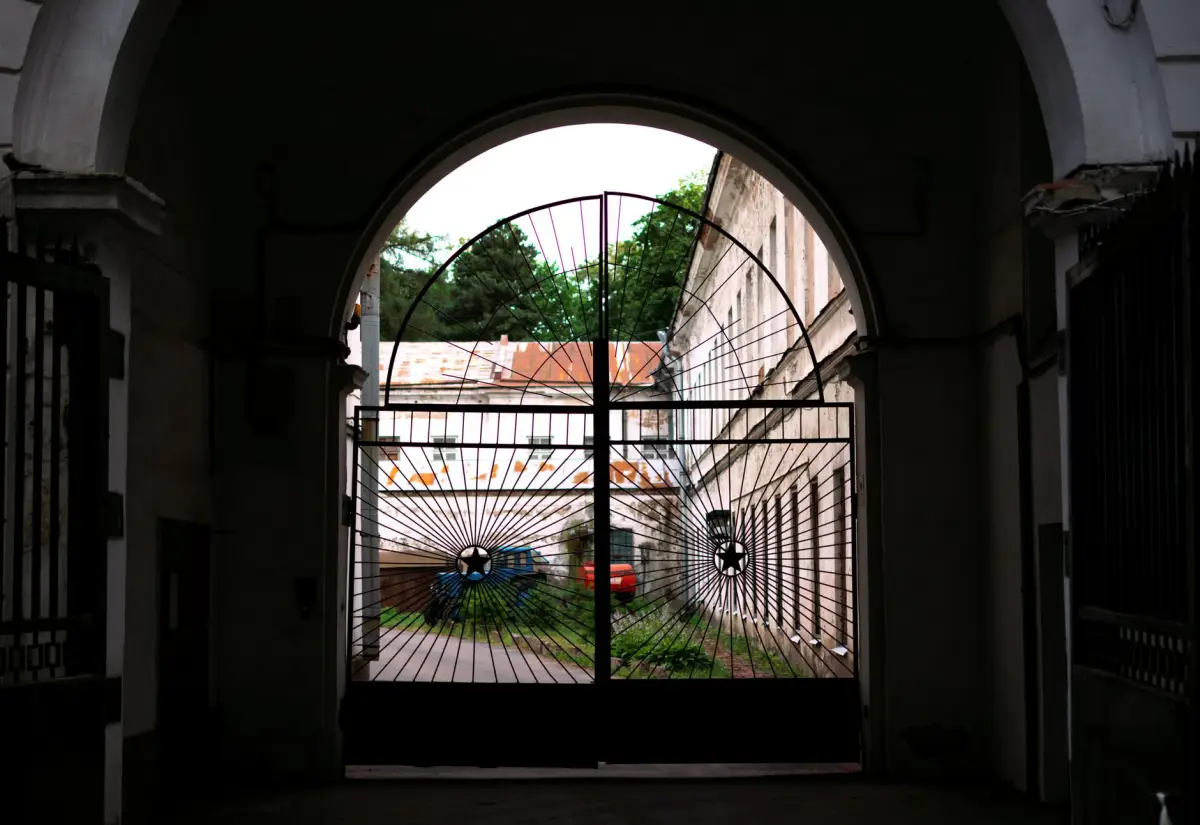

Swing Gate Installation in Elgin, IL
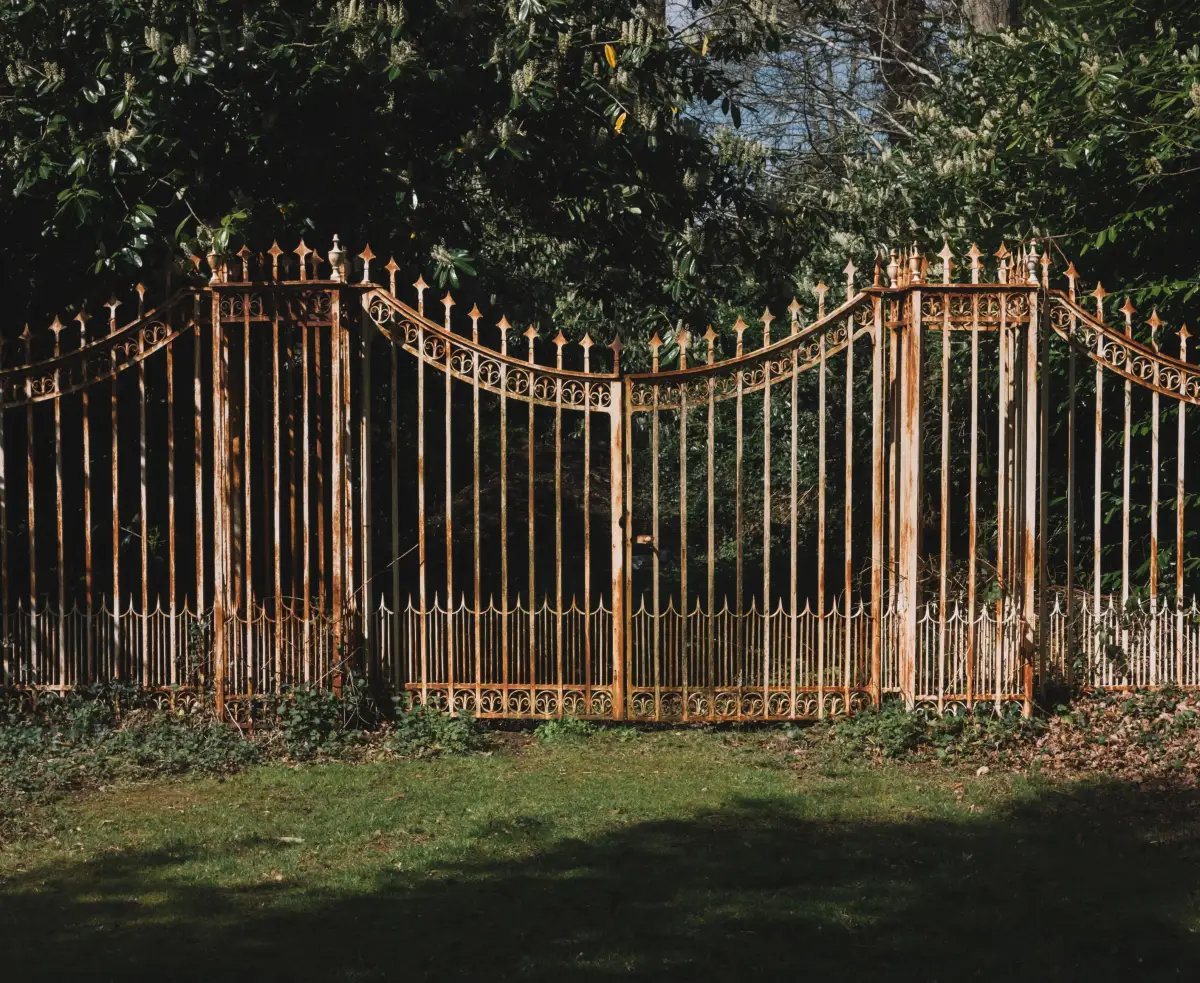
Single Swing Gates
One leaf, one hinge set, one thing to align — on an opening up to about 12 feet, a single swing gate is the simplest and cheapest gate that will do the job properly. Everything about it is easier: one operator if it's automated, one latch, one arc to keep clear. The physics turn against it as the leaf gets longer, because the load on the top hinge grows with the distance out to the free end. That's the mechanism behind a driveway gate sagging: the frame racks from a rectangle into a parallelogram, the latch corner drops, and the owner starts lifting the gate to get it to close. Preventing it is a design job — adequate frame wall thickness, a diagonal brace or tensioned internal cable, and hinges rated comfortably above the leaf weight rather than exactly at it. On a pedestrian-width or single-car opening, none of this is hard. On a 14-foot span it's a losing fight.
Double Swing Gates
A bi-parting pair splits a wide opening into two leaves that meet in the middle, halving the span each hinge set has to carry and roughly quartering the sag problem. It's the standard answer above about 12 feet. The tradeoff is more hardware and one extra alignment relationship to maintain: the two leaves have to meet each other cleanly as well as meet their posts. A centre stop in the drive gives the active leaf something to close against, and a drop rod or cane bolt pins the passive leaf so it doesn't drift. When a double gate won't latch, the cause is usually one of three things — a bent or worn drop rod, a centre stop heaved by frost, or one leaf having racked enough that the two no longer meet square. Diagnosing which requires closing each leaf independently and watching where the geometry goes wrong.
Automatic Swing Gates
Swing operators come in three broad types and they suit different gates. Articulated arm operators are the most forgiving of a gate that isn't perfectly true and the easiest to service, which makes them the common residential choice. Linear ram operators are compact and strong but less tolerant of a leaf that moves around. Underground operators disappear from view entirely, which genuinely matters on an ornamental gate where a visible arm would spoil the design — but they live in a housing that must drain properly, because a housing that fills with meltwater and freezes is a gate that doesn't open in January. Every swing gate has two entrapment points, the leading edge and the hinge side, and UL 325 requires protection in each direction of travel. On a bi-parting pair the operators also need sequencing so the passive leaf lands first; mis-sequenced operators are a common reason a double gate stops latching after automation.
Manual Swing Gates
A manual swing gate is the lowest-maintenance gate there is, and on a secondary entrance or a property where the gate gets used a few times a day it's often the right answer regardless of budget. There's no operator to fail, no power run, no safety devices to keep aligned, and nothing that stops working during an outage. What makes one pleasant rather than annoying is hinge quality and honest weight. A heavy ornamental leaf on marginal hinges develops play, the play becomes sag, and a gate that swung with one finger starts needing a shove. Barrel hinges with a proper thrust bearing carry weight better over time than a simple J-bolt arrangement. It's also worth building a manual gate as though it might be automated later — specifying the frame for mechanical cycling and stubbing conduit in costs little now and saves a great deal if the decision changes.
Custom Metal Driveway Swing Gates
Most swing gates on Elgin driveways are custom, because the opening between two existing posts is rarely a catalog width and the ground under the arc is rarely perfectly flat. Custom fabrication lets the top rail follow a rising grade rather than leaving a wedge-shaped gap at one end, and lets the bottom rail be set at a height that clears the high point of the arc without leaving a gap a dog can get through at the low point. It also lets the frame be specified for its actual span — the single biggest predictor of whether the gate will still be square in ten years. On the east side, near the Gifford Park and Spring–Douglas historic districts, custom is often mandatory for a different reason: the gate has to match ironwork already standing, on pattern and picket spacing rather than just colour, and the design goes through a Certificate of Appropriateness review. See custom metal gates.
Signs a Swing Gate Fits Your Property
- The drive is level across the opening or falls away from the house
- There's clear space inside the property for the leaf to arc through, and it stays clear in winter
- The apron is long enough that a waiting vehicle sits clear of the road during the opening cycle
- The opening is under about 12 feet, which suits a single leaf, or you're happy with a bi-parting pair above that
- You want the least hardware and the least maintenance of any configuration
- There's no clear run beside the opening for a slide to park into
- The gate needs to match existing ironwork, where a traditional swing pair is the natural form
How a Swing Gate Gets Specified and Installed

- 1
Arc and grade survey
The measurement that matters is taken along the arc, not at the posts. A level gets run across the full sweep the leaf will travel, because the high point is almost always somewhere in the middle rather than at either end. A rise of even a couple of inches within that arc determines how high the gate has to be hung, which in turn determines how large a gap is left underneath at the low point — and whether that gap is acceptable depends on whether a small dog or a small child lives behind it. Frost movement gets factored in as well: an apron that measures level in August can sit an inch higher in January, so a gate hung with no clearance margin will drag through winter and swing freely in summer. Arc direction gets decided here too, including where snow gets piled, since a leaf that arcs into the winter snow pile is a leaf that stops opening.
- 2
Leaf configuration and frame design
Opening width sets the first decision: single leaf below roughly 12 feet, bi-parting above it. Then leaf weight gets calculated rather than estimated, since it drives the hinge rating and, on an automated gate, the operator class. This is where sag is designed out. A long leaf needs either a diagonal brace running from the bottom hinge corner to the top latch corner, or an internal tensioned cable doing the same job less visibly, plus frame tube with enough wall thickness to resist racking in the first place. Solid infill gets flagged, because a panel gate catches wind — relevant both to hinge loading and, if automated, to operator sizing. On a bi-parting pair, the centre stop and drop rod arrangement gets specified now rather than improvised at install.
- 3
Posts, footings and hanging
A JULIE locate goes in before digging. Gate posts carry loads no fence post sees, particularly the hinge post, which takes the entire leaf weight as a cantilevered load trying to pull it out of plumb. Footings go below Elgin's 42-inch frost depth — below it, not to it — because a footing ending inside the frost zone gets jacked upward a fraction each freeze-thaw cycle, and on a swing gate the symptom is unmistakable: the gate gradually stops meeting its latch and eventually needs lifting to close. Posts cure fully before any weight goes on them, since hanging a leaf on green concrete guarantees a lean within a season. The leaf goes up, gets shimmed square, and gets swung through its full arc to confirm it clears the ground everywhere rather than only at the closed position.
- 4
Hardware, automation and final alignment
Latch, drop rod or cane bolt gets set last, aligned to where the gate actually rests rather than where the drawing says it should. On a bi-parting pair, the passive leaf is pinned first and the active leaf aligned to it. Where an operator is being fitted, travel limits get set so the gate stops cleanly rather than driving into its stops, and the two leaves get sequenced so the passive one lands before the active one closes against it. Then the safety system is tested rather than assumed: both entrapment points on each leaf, in both directions of travel, with each device deliberately triggered. ASTM F2200 construction items get verified on the gate itself — frame openings under 2.25 inches, smooth bottom edges with protrusions no greater than half an inch, and construction such that the gate won't fall more than 45 degrees from vertical if it detaches from its hardware.
What Do Swing Gates Cost in Elgin, IL?
- Opening width, and whether it's spanned by a single leaf or a bi-parting pair
- Leaf weight and infill — solid panels add weight and wind load, both of which drive hinge and operator spec
- Frame stock and internal bracing, which is what keeps a long leaf from racking
- Hinge type and rating: barrel hinges with thrust bearings cost more than a J-bolt arrangement and carry weight better over time
- Hinge post footing, which takes the leaf weight as a cantilevered load and gets sized for it
- Ornamental content — scrolls, collars, finials, and cast versus forged components
- Automation: operator type (arm, ram or underground), safety devices, and sequencing on a bi-parting pair
- Centre stop, drop rod and latch hardware on double gates
- Permit, and the Certificate of Appropriateness review in a historic district
Hinges are the line item most worth spending on and the one most often quietly downgraded. A hinge rated exactly at the leaf weight is a hinge running at its limit every cycle for years, and the failure is gradual rather than dramatic — play develops, the leaf drops, the frame starts racking to follow it, and eventually the gate needs lifting to latch. By that point the fix is not a new hinge, it's straightening or replacing the leaf as well. Rating the hinges comfortably above the load costs very little at the outset.
What to Look for in an Elgin Swing Gate Installer
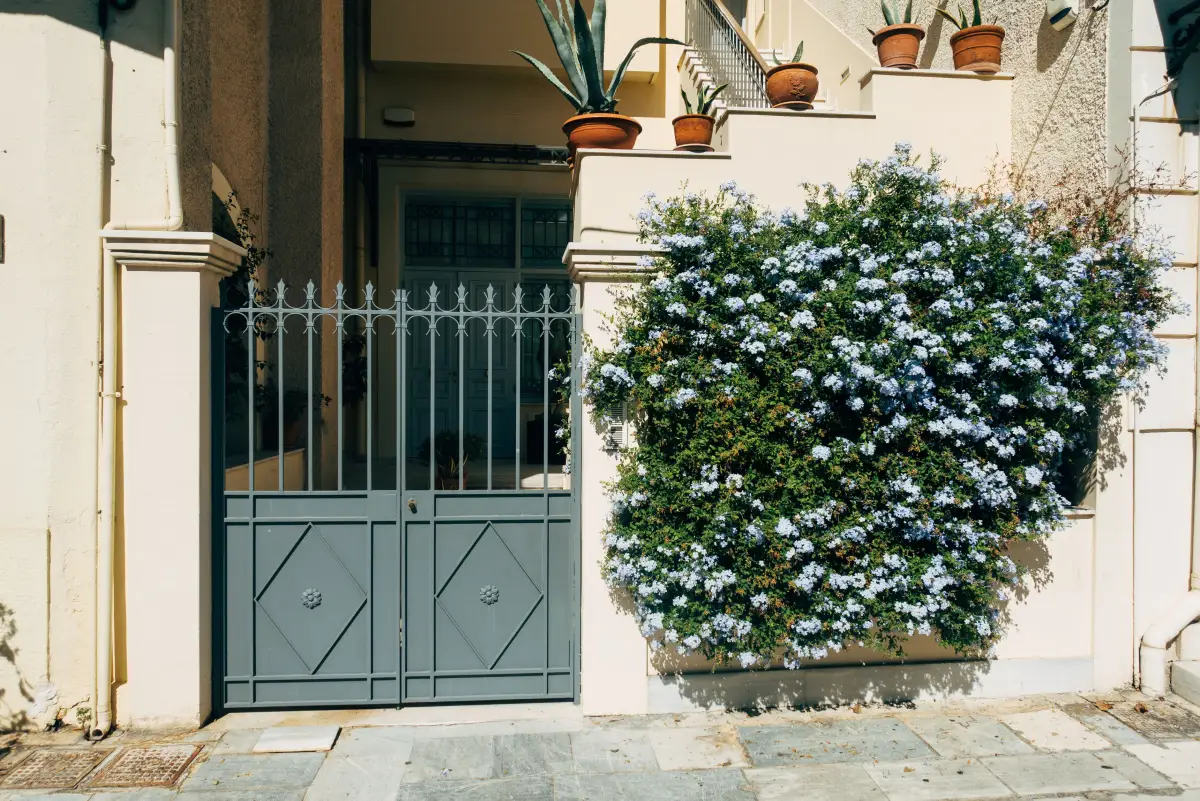
Grade Checked Across the Whole Arc
The high point is usually in the middle of the sweep, not at the posts. An installer who measures only at the posts is going to hang the gate wrong.
Sag Designed Out, Not Warrantied Around
A diagonal brace or tensioned internal cable and adequate frame wall thickness are what keep a long leaf square. Both cost less than the repair.
Hinges Rated Above the Load
Not at it. Ask what the hinges are rated for and what the leaf weighs — an installer who knows both numbers has done the work.
Frost Movement Factored Into Clearance
An apron that's level in August sits higher in January. A gate hung with no margin drags all winter and swings freely all summer.
Snow Handling Discussed
An inward arc needs the space inside the gate to stay clear. Where snow gets pushed belongs in the design conversation, not discovered in December.
Fixed Quotes, Decided On-Site
Arc, grade, post conditions and leaf weight get checked and the number gets set before anything is fabricated.
Residential & Commercial Swing Gates
Residential
Most Elgin homes with a level drive and room to arc end up with a swing gate, and that's the right outcome — it's the least hardware for the job. Bi-parting pairs are common on the wider west-side subdivision approaches, single leaves on narrower openings and on walk-through entrances. The recurring design question on older east-side lots is whether the existing masonry pier can carry a leaf at all; many were built decorative, with no steel inside them.
Commercial
Commercial swing gates need more hinge and more frame for the same opening, because cycle count multiplies every load the gate sees. Where a swing arc would intrude into a traffic lane or a parking aisle, a slide is usually specified instead. See commercial metal gates.
When a Swing Gate Isn't the Right Call
- The drive rises anywhere along the arc. A swing gate will clear it in summer and drag in winter, and no amount of hinge quality fixes a grade problem — look at sliding gates.
- There isn't a car length between the gate and the road. A swing gate blocks the drive for its whole opening cycle, which holds a waiting vehicle in traffic.
- The area the leaf arcs through is where snow gets piled every winter, and there's nowhere else to put it.
- Your existing swing gate is sagging or won't latch. That's metal gate repair — usually hinges, bracing or a heaved post — not a replacement.
- The property is outside Kane, Cook, DuPage, McHenry and Lake Counties.
Related Services
- Driveway Gates in Elgin, IL
The wider vehicle-entrance decision, including apron length and grade.
- Sliding Gates in Elgin, IL
What to do instead when the grade or the apron rules a swing gate out.
- Automatic & Electric Gates in Elgin, IL
Swing operators, leaf sequencing on bi-parting pairs and UL 325 safety devices.
- Metal Gate Repair in Elgin, IL
Sagging leaves, hinge wear, heaved posts and gates that won't latch.
Serving Nearby Cities
Gate work across Kane, Cook, DuPage, McHenry & Lake Counties. Each city page covers the local permit requirements, footing depth and the configurations that come up most often there.
- South Elgin
- Streamwood
- Bartlett
- Carpentersville
- Hanover Park
- Hoffman Estates
- St. Charles
- Algonquin
- Schaumburg
- Lake in the Hills
- West Chicago
- Carol Stream
- Huntley
- Batavia
- Glendale Heights
- Palatine
- Crystal Lake
- Wheaton
- Arlington Heights
- Addison
- Lombard
- Mount Prospect
- Buffalo Grove
- Aurora
- Elmhurst
- Des Plaines
- McHenry
- Naperville
- Downers Grove
- Woodstock
Frequently Asked Questions
- How wide can a single swing gate be?
- Around 12 feet is the practical limit before the leverage on the hinges makes sag a matter of when rather than whether. Beyond that, a bi-parting pair halves the span each hinge set carries and is the standard solution. It's possible to build a longer single leaf with heavy frame stock and serious bracing, but you're paying more for a gate that's still working harder than a pair would.
- Why won't my swing gate latch anymore?
- Two likely causes, and they need different fixes. Either the leaf has racked — the frame has gone out of square under its own weight, dropping the latch corner — or the post has moved, which in Elgin usually means a footing that didn't get below the 42-inch frost depth and has been heaved by freeze-thaw cycles. Check whether the gap between gate and post is even from top to bottom: a wedge-shaped gap points at racking, a whole gate leaning points at the post. See [metal gate repair](/services/metal-gate-repair).
- Should a swing gate open inward or outward?
- Inward is standard, because it keeps the leaf off the public way and out of the path of passing traffic. It requires the space inside the property to stay genuinely clear, including in winter — a leaf that arcs into the snow pile stops opening in December. Outward swing is occasionally used where the interior space doesn't exist, but it has to be checked against setbacks and against sight lines at the road.
- Can a swing gate work on a sloped driveway?
- It depends on which way the slope runs. A drive that falls away from the house is usually fine, since the leaf swings into increasing clearance. A drive that rises toward the house is the problem case: the leaf either catches the grade or has to be hung high enough that the gap underneath defeats the purpose. Frost makes it worse, since the apron sits higher in January than it did when the gate was hung. On a rising drive, a slide is the reliable answer.
- What's the difference between barrel hinges and J-bolt hinges?
- A J-bolt arrangement is simple, adjustable and inexpensive, and it's fine on lighter leaves. Barrel hinges, particularly with a thrust bearing carrying the vertical load, handle heavier gates with less developed play over time. Since play is what eventually becomes sag, hinge choice on a heavy ornamental leaf has more to do with how the gate looks in ten years than with how it works on day one.
- Do double swing gates need a centre stop?
- Effectively, yes. The active leaf needs something solid to close against and the passive leaf needs pinning so it doesn't drift, which is what a centre stop plus a drop rod or cane bolt provides. When a double gate stops latching, a bent drop rod or a centre stop heaved out of position by frost is one of the more common causes — worth checking before assuming the gate itself has moved.
Learn More
- City of Elgin — Fence Permit Quick Guide — Elgin's permit requirements, street-yard height limits, and the Certificate of Appropriateness rule for historic-district properties.
- DASMA — An Installer's Guide to ASTM F2200 — The construction requirements an automated gate has to meet: gap limits, bottom-edge protrusions, and how the gate has to behave if it leaves its hardware.
- American Galvanizers Association — Duplex Systems — Why hot-dip galvanizing under powder coat outlasts either finish on its own, particularly where road salt is in play.
Get a Quote for Swing Gates in Elgin, IL
Send over the opening you’re working with and get an on-site measurement and quote — no charge for the estimate, no obligation to book it.
Get My Free Estimate