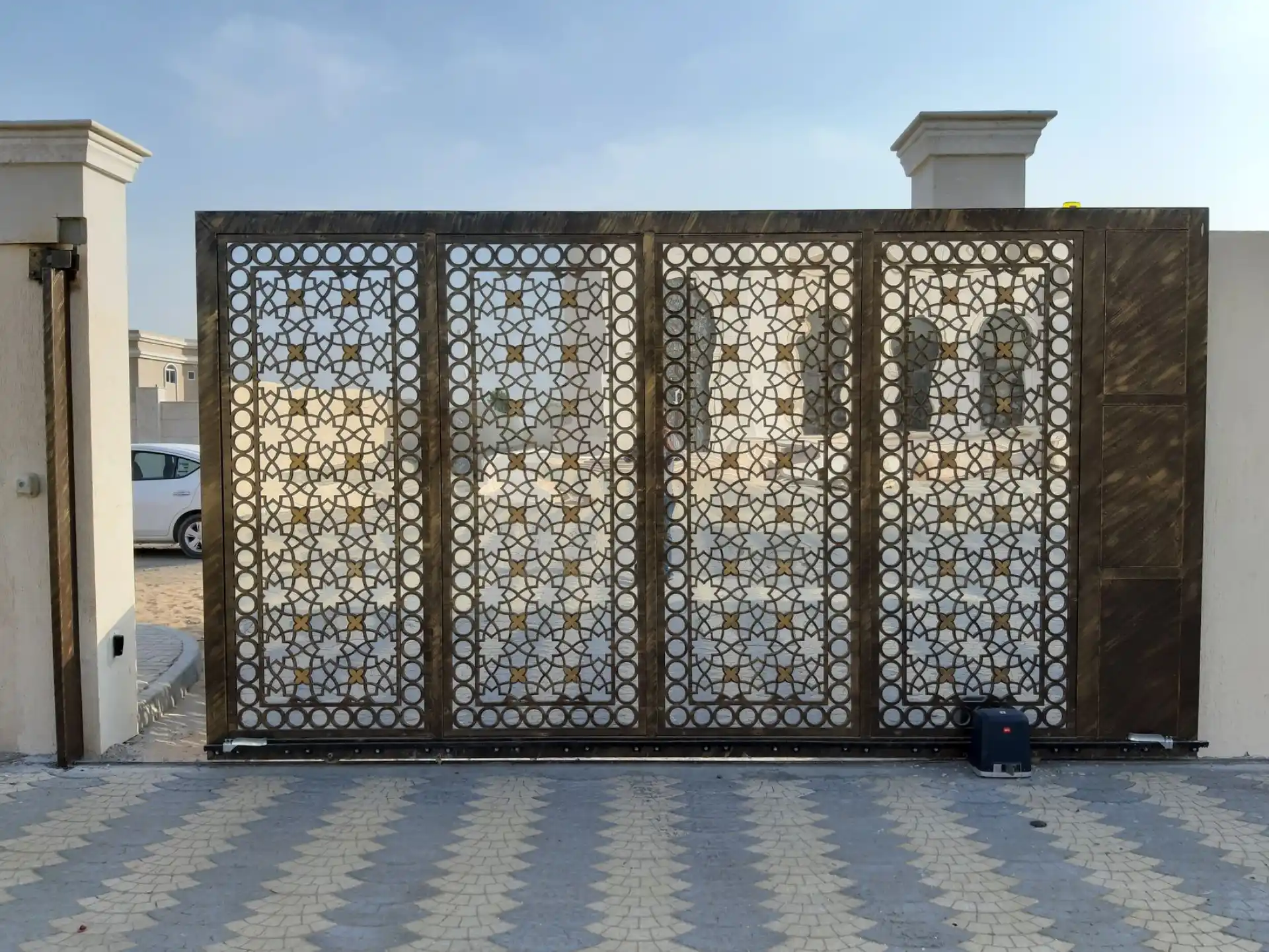
Sliding Gates in Elgin, IL — Residential & Commercial Slide Gate Specialists
When the drive rises toward the house or a car would sit in the road waiting, a slide is the answer. Cantilever systems keep the leaf off the ground and out of the ice.
Elgin Elite Metal Gates is your local resource for sliding gates, cantilever slide systems and gate automation across Elgin, Kane County and the Fox Valley. We work with experienced fabricators who choose between cantilever and V-track based on what a Fox Valley winter does to a ground-level track.
A sliding gate travels parallel to the fence line instead of arcing across the drive, which makes the grade under the opening irrelevant. That single property is why slides get specified on the older lots east of the Fox River, where drives climb from the street toward the house and a swing leaf would carve into the asphalt every time frost lifts the apron.
The second reason is space in front. A slide begins clearing the opening the instant it moves, so a vehicle isn't held in the roadway waiting for a leaf to complete its arc. On a short apron that's a safety difference, not a convenience one.
What a slide demands in return is room beside the opening. The gate has to park somewhere — roughly the width of the opening again for a V-track design, plus a counterbalance tail on a cantilever. Where that side room doesn't exist, no amount of budget makes a slide work, and the conversation goes back to swing gates or to regrading.
What a Sliding Gates Quote Covers
- Measurement of the opening plus the clear run beside it, since the parked gate needs somewhere to go
- A cantilever-versus-V-track recommendation with the winter reasoning stated, not just the price difference
- Frame spec in writing — tube wall thickness, infill, and total leaf weight including the counterbalance tail
- Roller assemblies, guide rollers and end stops rated to the actual leaf weight
- Post footings below Elgin's 42-inch frost depth, with a JULIE locate placed before digging
- Track bed preparation and drainage where a V-track system is genuinely the right choice
- Slide operator sizing by leaf weight, length and duty cycle if the gate is automated
- UL 325 entrapment protection at the leading edge, the receiving post and the parked position
- Manual release demonstrated so the gate can be moved by hand during an outage


Sliding Gate Installation in Elgin, IL
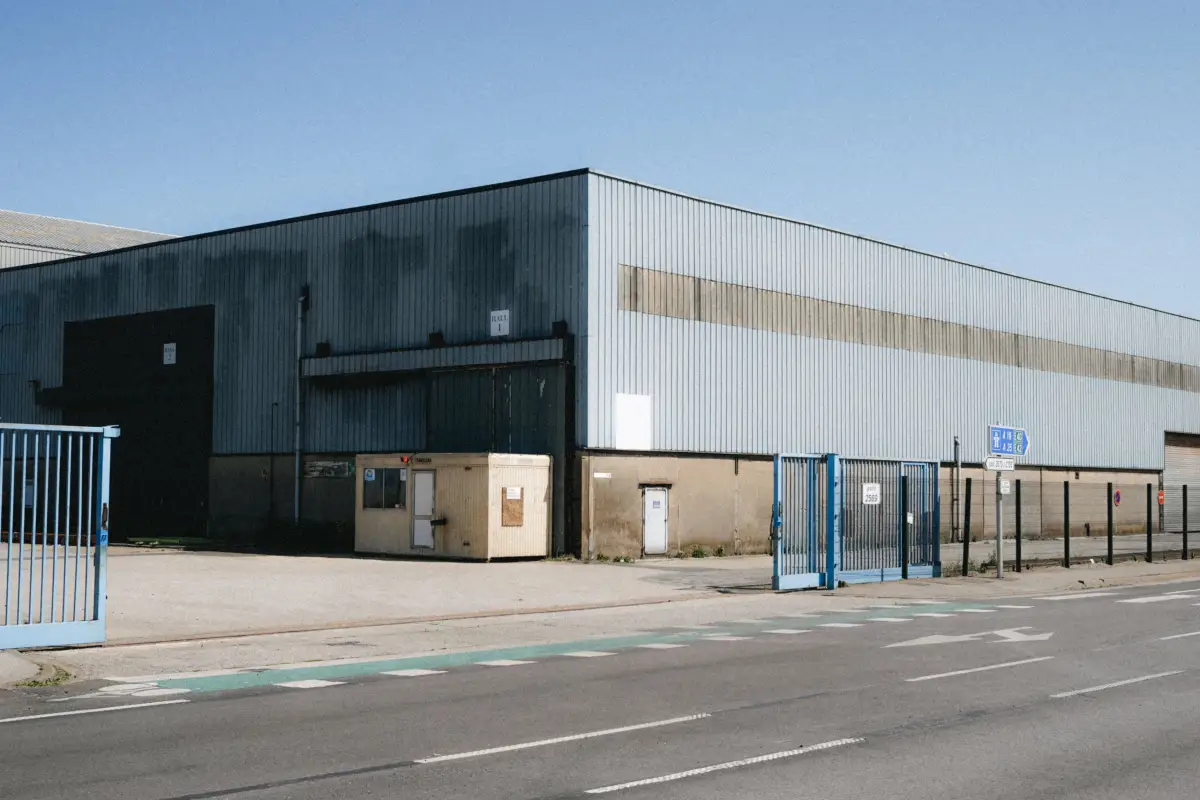
Residential Sliding Driveway Gates
On a house, a slide is usually chosen for one of two site problems rather than for looks. Either the drive rises toward the garage, which a swing leaf can't tolerate once frost heaves the apron, or the apron is too short to hold a waiting car clear of the street. Residential slides tend to be lighter than commercial ones, which lets them run on smaller operators and lighter roller assemblies, but the parking run is the same constraint at any scale — a 14-foot opening needs roughly 14 feet of clear space beside it, kept clear permanently. That last word matters. The most common residential slide complaint isn't mechanical, it's that the space the gate parks into gradually filled up with a woodpile, a trailer, or a snow bank, and now the gate stops short of fully open. Deciding where snow gets pushed each winter belongs in the design conversation.
Automatic Sliding Gates
Slide operators drive the gate along its run with a rack-and-pinion arrangement or a chain, and the cold-weather failure mode is specific enough to be worth naming. A V-track packed with grit, road salt and refrozen meltwater gives the motor real resistance, and the operator's obstruction sensing correctly reads that as something in the way and reverses. So a sliding gate that stops halfway and backs off every morning in January is very often not a motor fault at all — it's a track that needs clearing. Rack alignment is the other recurring issue: a rack that has drifted out of parallel with the pinion chews teeth, gets progressively noisier, and eventually skips. Both problems get caught early by anyone actually listening to the gate. If the operator is genuinely faulting rather than reacting, see gate opener repair.
Manual Sliding Gates
A manual slide is a reasonable choice on a secondary entrance, a side lot access, or anywhere the gate gets moved a few times a week rather than a few times a day. It is meaningfully cheaper, since there's no operator, no trenching, no safety devices and no power run. The catch is effort. A slide's rolling resistance rises sharply once the track is dirty or the rollers are worn, and a gate that opened with one hand in September can take two and a shoulder by February. Good rollers and a design that keeps the running surface out of the weather are what keep a manual slide pleasant to use. It's also worth specifying a manual gate as though it might be automated later — leaving the rack mounting surface and a conduit stub in place costs little now and saves a great deal if the decision changes.
Track Sliding Gate Systems
The real choice in slide gates is cantilever versus V-track, and in northern Illinois it usually resolves the same way. A V-track slide runs on a steel track fixed to the ground, with wheels riding in the V. It costs less, handles heavy leaves well, and needs that track kept clear — which in a Fox Valley winter means clearing it repeatedly, because packed snow and refrozen slush will stop the gate. A cantilever slide carries the leaf on roller assemblies mounted to posts, so nothing touches the ground at all; the leaf is counterbalanced by a tail that extends past the opening. Nothing on the ground means nothing to freeze, which is why cantilever is the default recommendation here despite the higher hardware cost and the extra room the tail requires. Where a ground track is unavoidable, drainage under the track bed does most of the work of keeping it usable.
Sliding Gates for Limited-Space Properties
Slides get recommended for tight sites, but they aren't automatically the space-saving option — they trade space in front of the gate for space beside it. On a narrow east-side lot with a stone pier on one side and a neighbouring wall on the other, there may be no parking run at all, and the honest answer is that a slide won't fit. Options then include a bi-parting slide, where two shorter leaves retract in opposite directions and each needs only half the run, or reverting to a bi-parting swing pair if the grade permits. A telescoping slide, where nested leaves stack as they retract, cuts the required run further at a real cost in hardware complexity and maintenance. The measurement that settles it is the clear run beside the opening — measured to a permanent obstruction, not to where the car usually parks.
Signs a Sliding Gate Is the Right Choice
- The drive rises toward the house, so a swing leaf would eventually catch the grade
- There's less than a car length between the gate line and the road
- The opening is wide enough that a single swing leaf would sag, but there's a clear run alongside it
- Snow gets pushed into the area a swing leaf would arc through every winter
- You've already got a swing gate that scrapes, drags, or has to be lifted over a high spot
- Vehicles need to start clearing the opening immediately rather than waiting out a full arc
- A cantilever design is worth the extra cost because nobody wants to chip ice out of a ground track in January
How a Sliding Gate Gets Specified and Installed

- 1
Opening and run measurement
Two measurements decide the job. The first is the clear opening. The second, and the one that most often kills a slide design, is the usable run beside the opening measured to a permanent obstruction — a wall, a pier, a mature tree, a property line — not to whatever happens to be parked there. For a cantilever design, the counterbalance tail extends past the opening as well, so the required run is longer than the opening width alone. Ground along the run gets checked for level and for what's under it, since the roller posts carry the entire leaf weight and need proper footings. This visit is also where the winter question gets asked directly: where does snow get pushed, and does that pile land in the gate's parking run? A design that works in September and is blocked from December to March is a design nobody is happy with.
- 2
Cantilever or V-track selection
This is the decision that determines how the gate behaves for the rest of its life. Cantilever keeps the leaf entirely off the ground on post-mounted roller assemblies, so there's nothing for snow, ice, salt or grit to pack into — the reason it's the usual recommendation in this climate. The costs are a longer required run for the counterbalance tail, heavier posts to carry the cantilevered load, and more hardware. V-track puts a track on the ground and rides wheels in it. It's cheaper, tolerates very heavy leaves, and asks the owner to keep the track clear all winter. Where V-track is chosen, the track bed gets drainage designed under it, because standing water that freezes in the channel is what turns a working gate into a stuck one.
- 3
Posts, footings and hardware
A JULIE locate goes in before digging. Slide gate posts carry loads a fence post never sees — on a cantilever design, the whole leaf hangs off two roller posts — so they get sized and footed for that, below Elgin's 42-inch frost depth. Below it, not to it: a footing terminating inside the frost zone gets lifted a fraction each freeze-thaw cycle, and on a slide the symptom is a gate that starts binding at the same point in its run as the roller path goes out of alignment. Roller assemblies, guide rollers and end stops get rated to the calculated leaf weight rather than the estimated one. If the gate is being automated, the rack mounting surface and conduit go in at this stage, while the ground is open and before any drive surface is patched.
- 4
Alignment, automation and testing
The gate gets run through its full travel by hand first, from fully closed to fully parked, feeling for any point where it binds or the effort changes. A slide that resists at one point will make an operator fight that resistance every cycle. Once the run is clean, the operator goes on and travel limits get set so the gate stops where intended rather than driving into its end stops. Obstruction sensitivity gets tuned, then every safety device is deliberately triggered and the response verified in both directions — a slide has entrapment points at the leading edge, at the receiving post, and in the gap between the parked leaf and the fence. ASTM F2200 items get checked on the gate itself: frame openings under 2.25 inches, smooth bottom edges, protrusions no greater than half an inch. The manual release gets demonstrated before handover.
What Do Sliding Gates Cost in Elgin, IL?
- Cantilever versus V-track — cantilever costs more in hardware and posts and asks less of the owner every winter
- Opening width, plus the counterbalance tail length on a cantilever design
- Leaf weight and infill, since solid panels add both weight and wind load
- Roller assembly rating, guide rollers and end stops matched to that weight
- Roller post footings, which carry the whole leaf on a cantilever and are sized accordingly
- Track bed preparation and drainage where a V-track system is used
- Automation: slide operator class, safety devices and vehicle detection
- Trenching for power and low-voltage runs, especially where the path crosses finished drive surface
- Bi-parting or telescoping designs where the parking run is too short for a single leaf
The most expensive mistake on a slide is discovering the parking run is too short after the gate is fabricated. It's a measurement anyone can take in five minutes, but it has to be taken to a permanent obstruction rather than to the current arrangement of the yard — a run that measures fine in June because the trailer happens to be elsewhere is not a run. Where the space genuinely isn't there, a bi-parting slide or a telescoping design will fit, but both cost more than a single leaf and both add hardware that needs maintaining.
What to Look for in an Elgin Sliding Gate Installer

The Run Gets Measured to a Permanent Obstruction
Not to where the car is parked today. A slide's parking run is the measurement that decides whether the design is possible at all.
A Reasoned Cantilever-Versus-V-Track Answer
Both work. In this climate, one of them asks you to clear a ground track every January. An installer should say which and why rather than defaulting to the cheaper hardware.
Roller Posts Footed for the Load
On a cantilever slide the roller posts carry the entire leaf. Their footings go below the 42-inch frost depth for the same reason every gate post does, and they're sized larger.
Snow Discussed in the Design
Where snow gets pushed decides whether the parking run stays usable in February. It's a five-minute conversation that prevents a season of frustration.
The Gate Run by Hand Before the Motor Goes On
Any point where a slide binds by hand becomes a point the operator fights every cycle. That check happens before automation, not after a callback.
Fixed Quotes, Decided On-Site
Opening, run, ground conditions and snow handling all get checked and the number gets set before fabrication starts.
Residential & Commercial Sliding Gates
Residential
Residential slides in Elgin are usually a response to grade or to a short apron. The east-side lots above the Fox River bring both — drives that climb from the street and very little room between the gate and traffic. The design constraint is almost always the parking run, since older lots are narrow and the space beside the opening is often already spoken for by a pier, a hedge or a neighbouring wall.
Commercial
Commercial slides carry heavier leaves, cycle far more often, and are frequently the only workable configuration on a lot where a swing arc would block a traffic lane. Cycle count drives the roller and operator spec more than weight alone does. See commercial automatic gates and industrial gates.
When a Sliding Gate Isn't the Right Call
- There's no clear run beside the opening. A slide has to park somewhere, and if the space isn't there permanently, a swing pair or regrading is the honest answer.
- The drive is level, the apron is long, and the budget is tight — a swing gate does the same job for less hardware and less to maintain.
- You want the cheapest possible system and are willing to accept a V-track you'll be clearing every winter. That's a legitimate choice, but make it knowingly rather than by default.
- Your existing slide gate came off its track or is binding — that's metal gate repair, not a new gate.
- The property is outside Kane, Cook, DuPage, McHenry and Lake Counties.
Related Services
- Driveway Gates in Elgin, IL
The wider decision — grade, apron length and swing versus slide for a vehicle opening.
- Swing Gates in Elgin, IL
The alternative configuration, and when a level drive makes it the better one.
- Automatic & Electric Gates in Elgin, IL
Slide operators, safety devices and what automation demands of the gate.
- Metal Gate Repair in Elgin, IL
Gates off track, worn rollers, binding runs and alignment problems.
Serving Nearby Cities
Gate work across Kane, Cook, DuPage, McHenry & Lake Counties. Each city page covers the local permit requirements, footing depth and the configurations that come up most often there.
- South Elgin
- Streamwood
- Bartlett
- Carpentersville
- Hanover Park
- Hoffman Estates
- St. Charles
- Algonquin
- Schaumburg
- Lake in the Hills
- West Chicago
- Carol Stream
- Huntley
- Batavia
- Glendale Heights
- Palatine
- Crystal Lake
- Wheaton
- Arlington Heights
- Addison
- Lombard
- Mount Prospect
- Buffalo Grove
- Aurora
- Elmhurst
- Des Plaines
- McHenry
- Naperville
- Downers Grove
- Woodstock
Frequently Asked Questions
- How much room does a sliding gate need beside the opening?
- Roughly the width of the opening again for a V-track design, and more than that for a cantilever, because the counterbalance tail extends past the opening. The critical part is that the run must be measured to a permanent obstruction — a wall, pier, tree or property line — rather than to whatever is currently parked there. Where the run is too short, a bi-parting slide splits the requirement in half, and a telescoping design cuts it further at a real cost in complexity.
- Is a cantilever gate better than a V-track gate?
- In this climate, usually yes, and for one specific reason: nothing touches the ground, so there's no track for snow, ice, road salt and grit to pack into. V-track is cheaper and handles very heavy leaves well, but it asks you to keep a ground-level channel clear through a Fox Valley winter. Cantilever costs more in hardware, needs heavier posts, and requires extra run for the tail. Which is right depends on budget and on how much winter maintenance you're willing to do.
- My sliding gate came off its track — what happened?
- Most commonly a worn or seized roller, debris in the track that lifted a wheel out of the channel, or a guide roller that failed and let the leaf lean far enough to jump. On a cantilever gate it's usually a roller assembly issue rather than anything at ground level. It's also worth checking whether a post has moved, since a heaved footing shifts the whole roller path out of alignment. Don't keep cycling it — running a derailed gate damages the rollers and the leaf. See [metal gate repair](/services/metal-gate-repair).
- Why does my sliding gate stop halfway and reverse?
- The operator is sensing resistance and treating it as an obstruction, which is exactly what it's supposed to do. On a slide that resistance is usually physical: a track packed with salt and refrozen slush, a worn roller that binds at one point, or a rack drifted out of alignment with the pinion. It gets noticeably more common in January here. Clearing the track and running the gate by hand to feel for a binding point will usually identify it before an operator is blamed.
- Can a sliding gate be installed on a sloped driveway?
- Yes, and that's often exactly why it's chosen. Because the leaf travels parallel to the fence line rather than arcing across the drive, the grade under the opening stops mattering. What does matter is the ground along the run, which needs to be consistent enough for the roller path to stay aligned. A significant slope along the run itself, rather than across the opening, is the case where a slide gets difficult.
- Do sliding gates need more maintenance than swing gates?
- V-track slides do, because the track has to stay clear. Cantilever slides are closer to a swing gate in upkeep — roller assemblies get inspected periodically and the run gets kept free of obstructions, but there's no ground channel collecting debris. Across all types, the maintenance that actually prevents failures is noticing early: a gate that's getting noisier or needs more effort is telling you something before it strands you.
Learn More
- DASMA — An Installer's Guide to ASTM F2200 — The construction requirements an automated gate has to meet: gap limits, bottom-edge protrusions, and how the gate has to behave if it leaves its hardware.
- JULIE — Illinois One-Call Utility Locate — The free locate request that has to go in before anyone digs a post hole in Illinois.
- City of Elgin — Fence Permit Quick Guide — Elgin's permit requirements, street-yard height limits, and the Certificate of Appropriateness rule for historic-district properties.
Get a Quote for Sliding Gates in Elgin, IL
Send over the opening you’re working with and get an on-site measurement and quote — no charge for the estimate, no obligation to book it.
Get My Free Estimate